01 · Comfort
Painting · drawing · writing
Doing it to relax, release, or feel calm — the kind of doing that arrives before a reason.
An interactive installation combining HTML / JavaScript game design, p5.js visual interaction, and an Arduino-based sensor system — designed to surface the paradox of non-teleological action: that the process itself can already be a form of result.
The project aims to express that the process itself can already be a form of result, and that meaning does not require an external purpose to be worthwhile. Process and outcome are always relative.
On the left: a vertical progression of six beliefs, each a different way to find — or refuse to find — purpose in what we do. On the right: research into utilitarianism and why the optimized, outcome-driven life can feel cold even when it is correct.
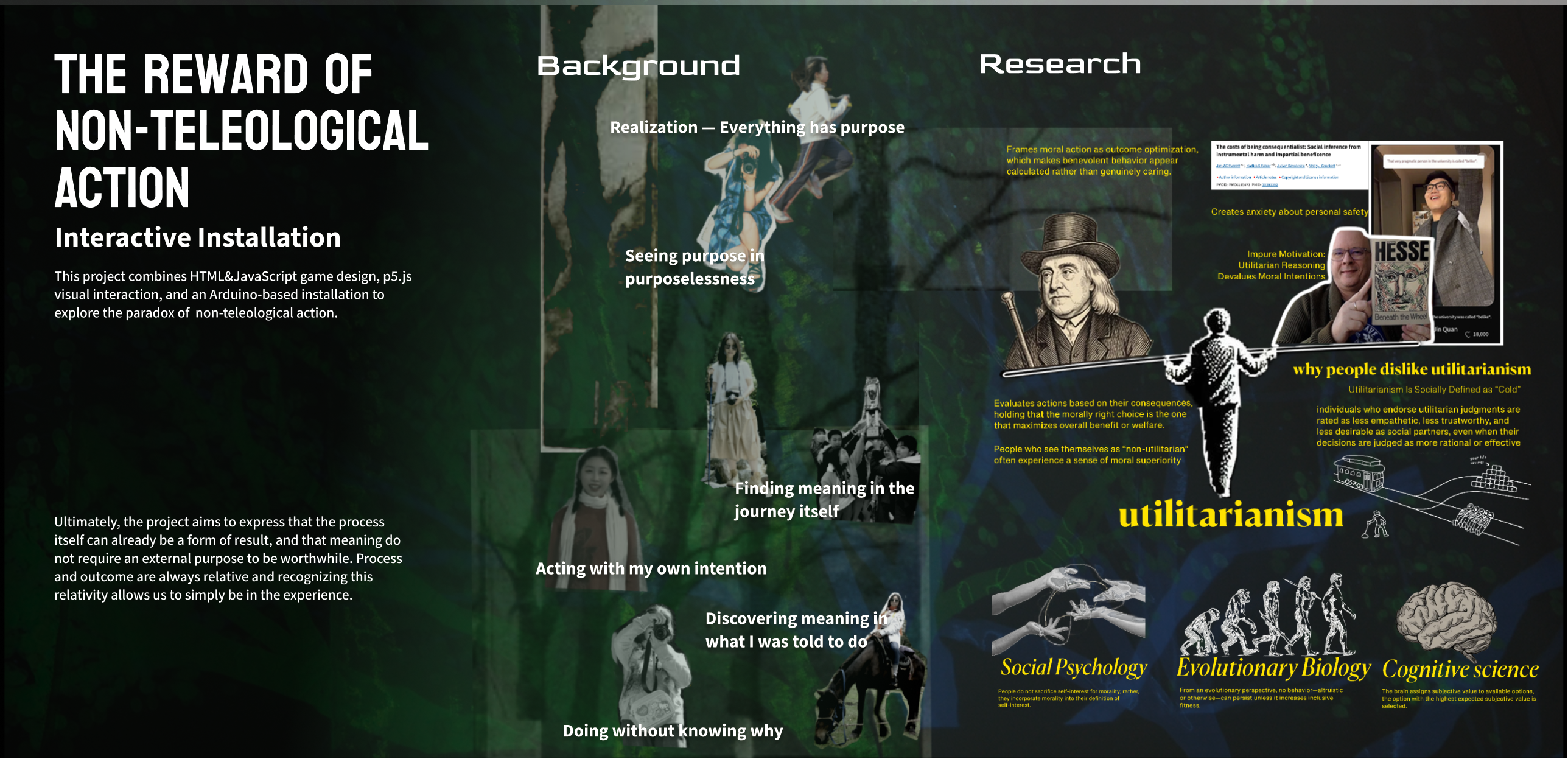
The research panel surfaces a contradiction: utilitarianism, viewed across Social Psychology, Evolutionary Biology, and Cognitive Science, holds that the morally right choice is the one that maximizes welfare — yet utilitarian reasoners are consistently rated as colder, less trustworthy, less desirable as social partners. The "right" answer comes at the cost of the right kind of person. This tension became the seed of the installation.
A "Welcome to draw Together" sign in a park. Strangers stopped, sat down, drew portraits of one another. Afterward, each was interviewed about why they did it. Twenty-eight motivations clustered into two flows — instinctive (yellow) and intentional (green) — converging on two emotions: ADD 14 instinctive paths leading to playful comfort, and 10 intentional paths leading to connection.
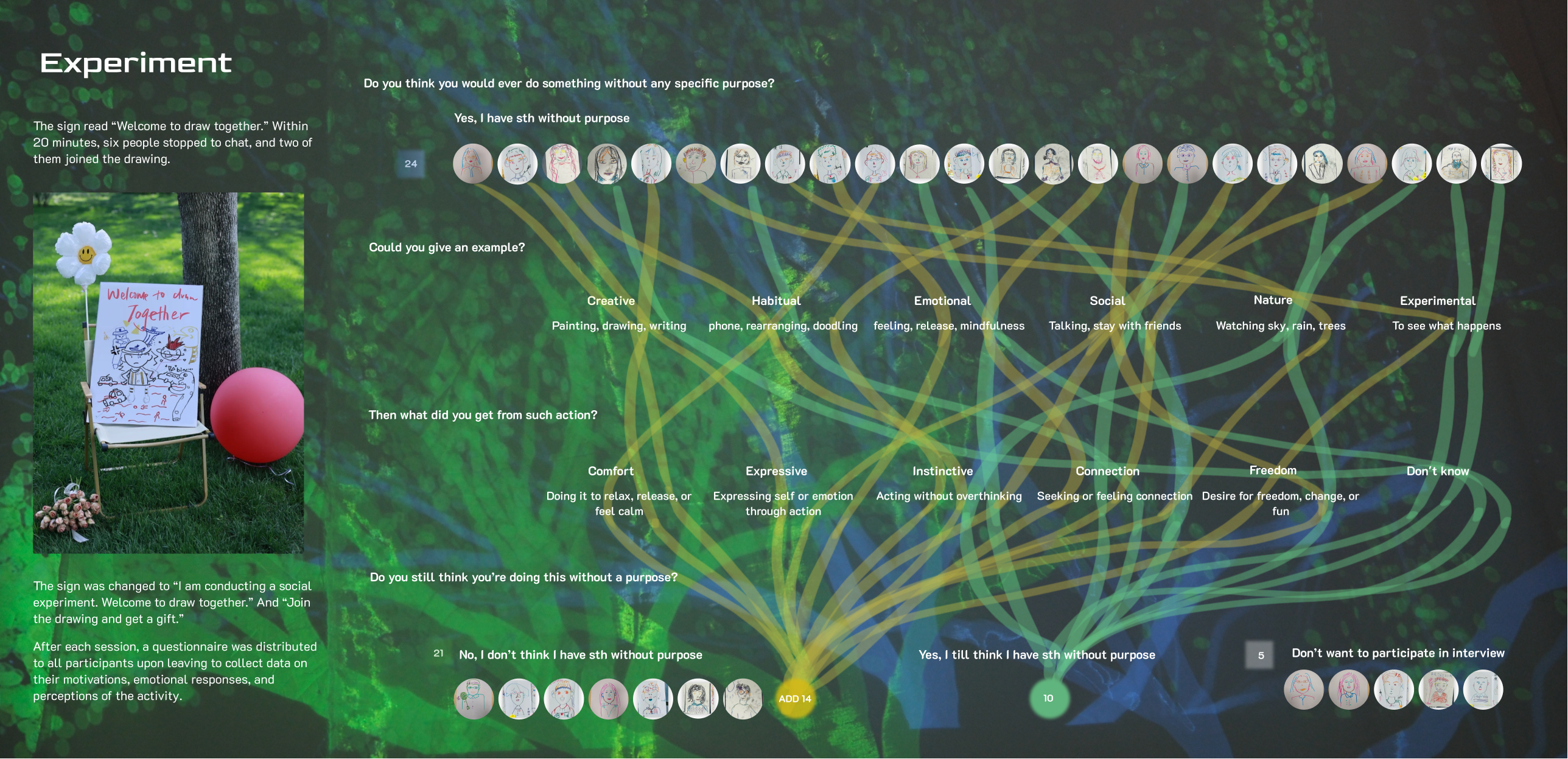
Doing it to relax, release, or feel calm — the kind of doing that arrives before a reason.
Expressing self or emotion through action when language doesn't fit.
Seeking or feeling connection — proximity is the point.
Curiosity acting before reason. The reward arrives in the surprise.
First came the references — Photosynthetic at ZERO Space Studio, the Windhover Contemplative Center. Then a 2D HTML game where the player held the spacebar to fight an attacker. Testing revealed players inferred the goal immediately from game conventions; the misdirection didn't land. The solution was to move out of game vocabulary entirely and into a meditation room — six sensor-driven phases that respond to stillness rather than action.
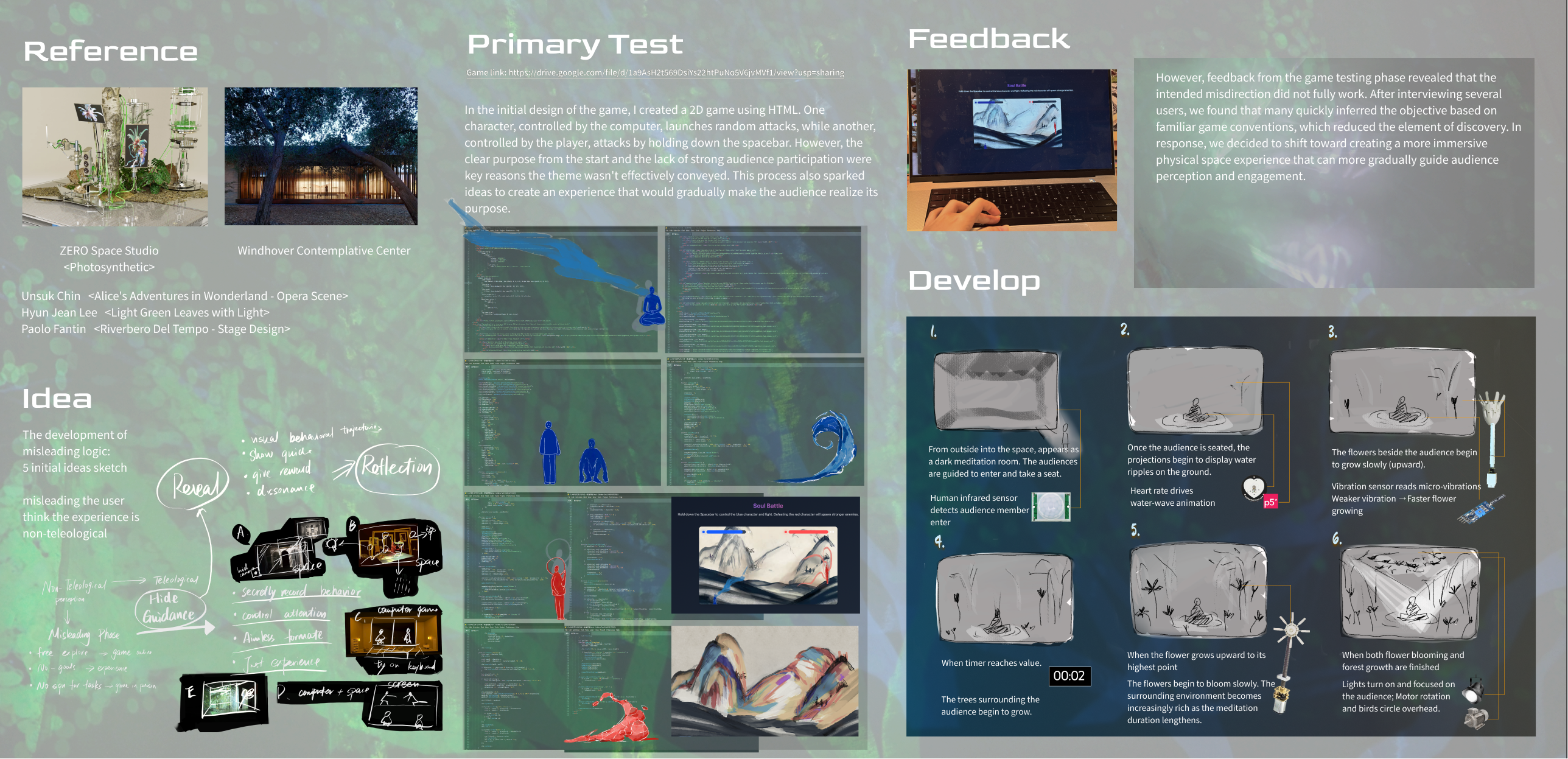
A dark meditation room. Human-infrared sensor detects the audience entering and taking a seat.
Projections begin to display water ripples on the ground. A heart-rate sensor drives the wave animation.
Flowers beside the audience grow slowly upward. Weaker micro-vibrations → faster flower growth.
When the timer reaches its value, the trees surrounding the audience begin to grow.
When the flower reaches its highest point, it begins to bloom slowly. The environment becomes increasingly rich as meditation duration lengthens.
When both flower blooming and forest growth are finished, lights focus on the audience; motor rotation and birds circle overhead.
Two Arduino UNOs read presence, vibration, and biometric input. The signals pass via wireless serial to a p5.js sketch that paints water ripples, growing trees, and a blooming forest of copper flowers wrapped in fabric. The right side shows the built room — the audience meditates among lit lilies; a slow choreography of birds, light, and growth unfolds around them.
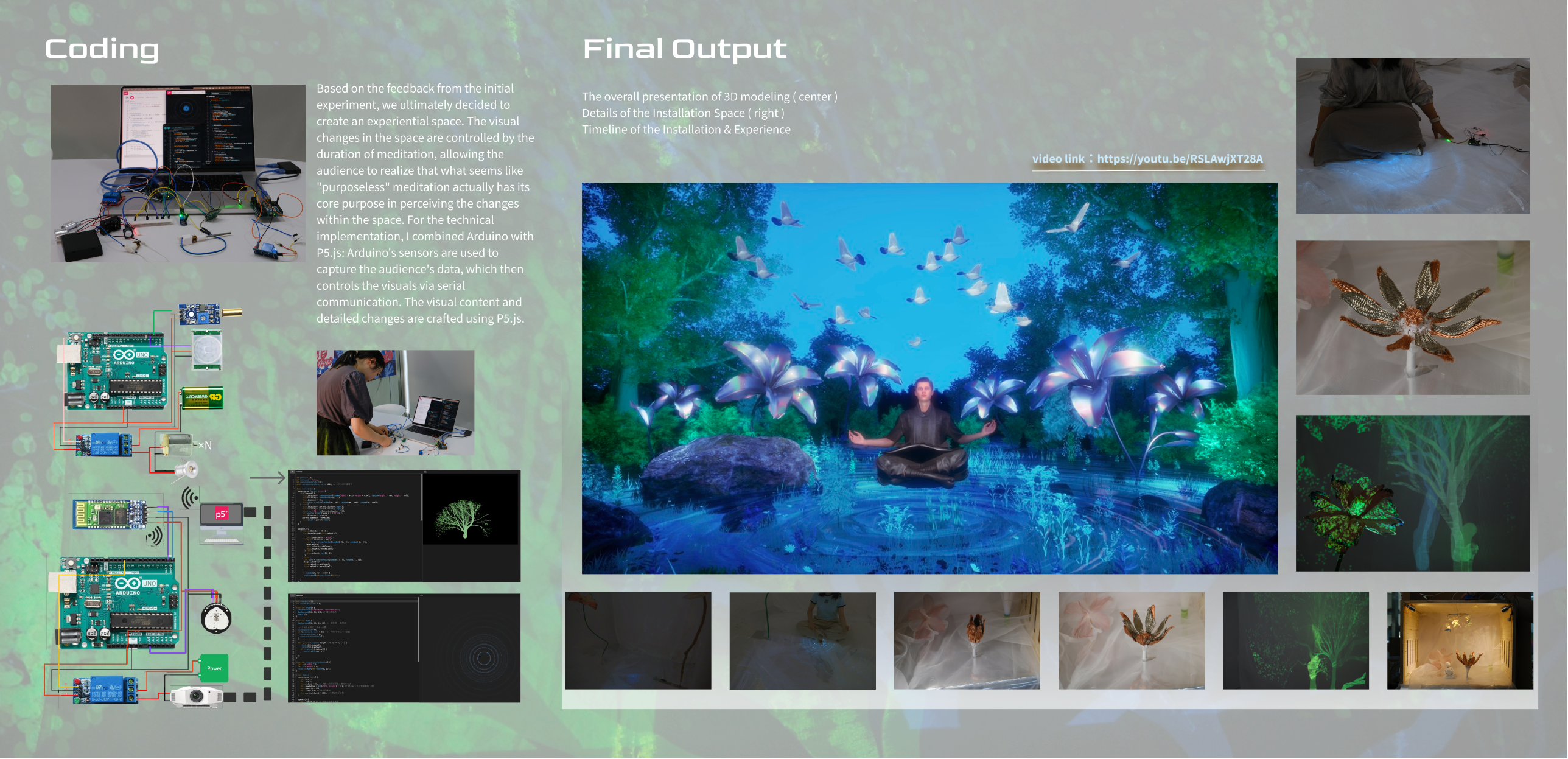
The system. Two Arduino UNOs sit in the side console — one wired to the human-infrared and vibration sensors, the other to the wireless module and projector relay. Values stream into p5.js, which renders the visual content in real time.
The space. Copper-wire lilies wrapped in translucent fabric stand around the meditation mat. Projections fall across the floor, the walls, and the petals themselves. The room responds to how still the body becomes.
Recognizing the relativity of process and outcome allows us to simply be in the experience. What at first felt like a purposeless meditation reveals its quiet core: a slow attention to the changes happening in the room — and in the body — when no one is keeping score.
— 2025 · Zhang Yichi