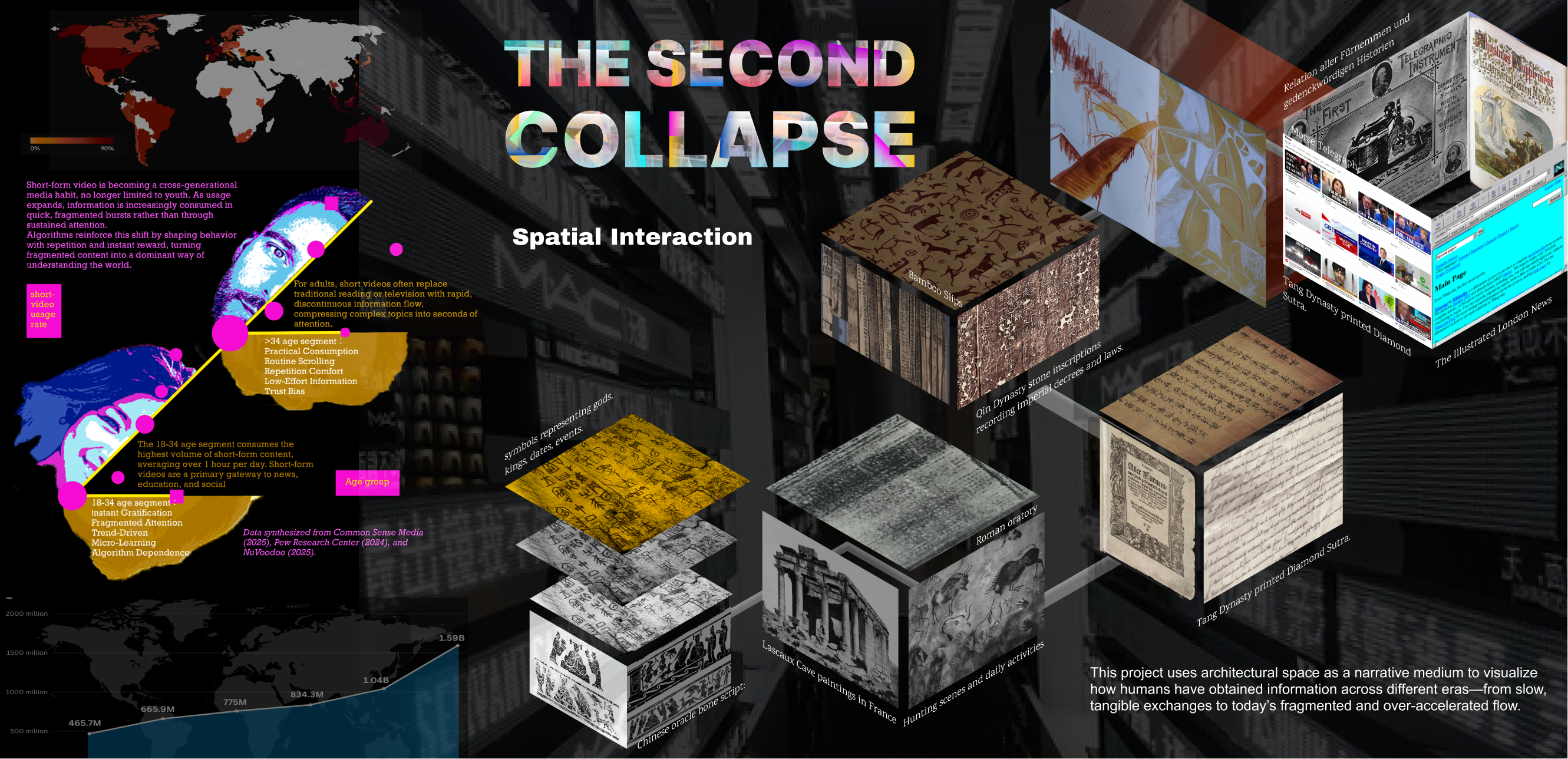
An architectural installation using built space as a narrative medium to visualize how humans have obtained information across different eras — from slow, tangible exchanges to today's fragmented and over-accelerated flow.
As communication becomes more instantaneous, our ability to acquire knowledge has ironically declined — because the information has become highly fragmented, complex, and attention-driven.
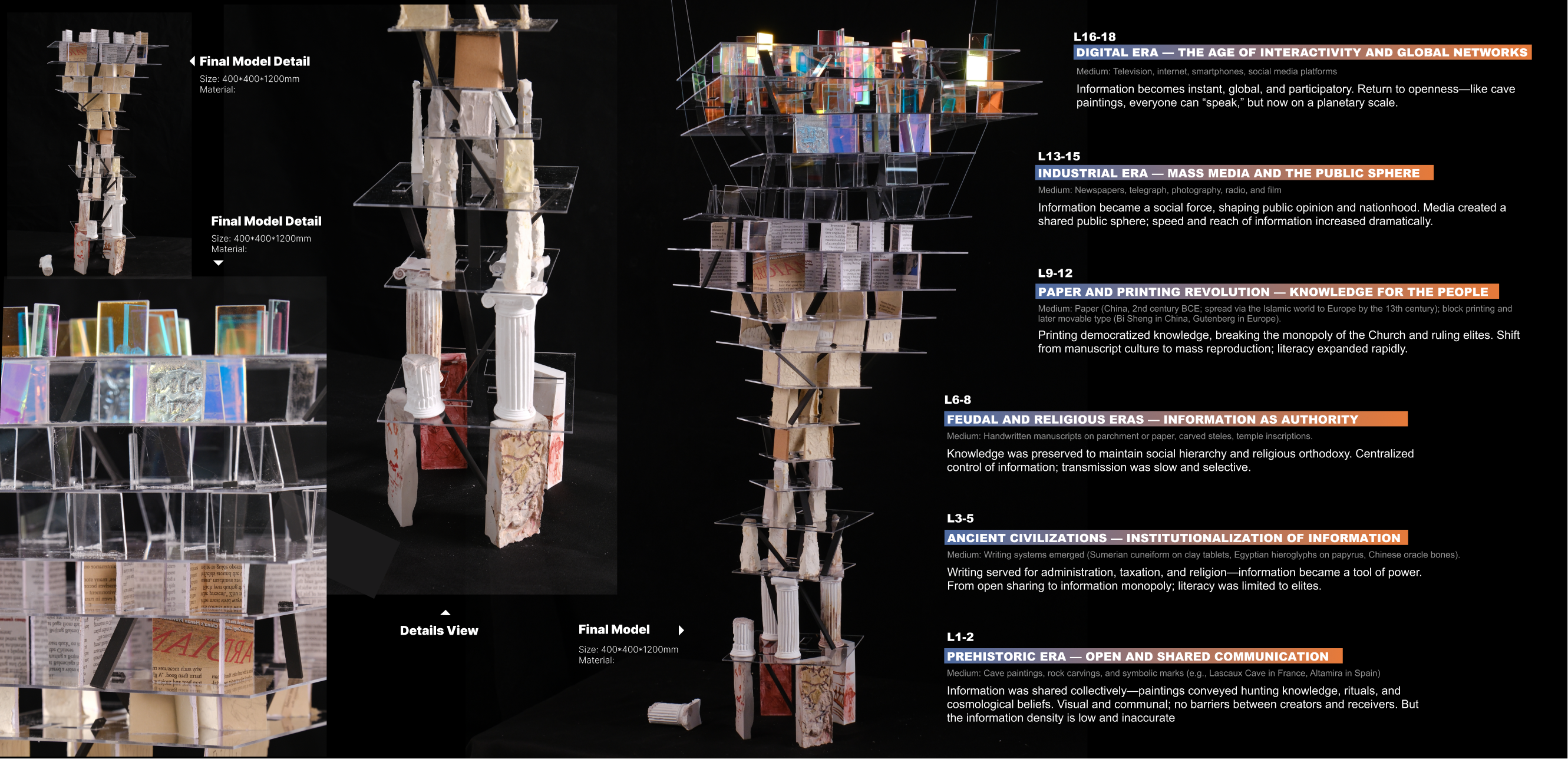
A tower with eighteen floors. Each cluster of floors marks an era in how humans have shared, controlled, or absorbed information — from cave paintings to short-form video. The form is architectural; the subject is attention.
Open and shared communication. Medium: cave paintings, rock carvings, symbolic marks — Lascaux in France, Altamira in Spain. Information was shared collectively; paintings conveyed hunting knowledge, rituals, cosmological beliefs.
Visual and communal. No barriers between creators and receivers — but information density was low and inaccurate.
Institutionalization of information. Medium: Sumerian cuneiform on clay tablets, Egyptian hieroglyphs on papyrus, Chinese oracle bones.
Writing served administration, taxation, and religion — information became a tool of power. From open sharing to information monopoly; literacy was limited to elites.
Information as authority. Medium: handwritten manuscripts on parchment, carved steles, temple inscriptions.
Knowledge was preserved to maintain social hierarchy and religious orthodoxy. Centralized control of information; transmission was slow and selective.
Knowledge for the people. Paper (China, 2nd century BCE) spread via the Islamic world to Europe by the 13th century. Block printing and later movable type (Bi Sheng in China, Gutenberg in Europe).
Printing democratized knowledge, breaking the monopoly of the Church and ruling elites. The shift from manuscript culture to mass reproduction; literacy expanded rapidly.
The public sphere. Medium: newspapers, telegraph, photography, radio, and film.
Information became a social force, shaping public opinion and nationhood. Media created a shared public sphere; the speed and reach of information increased dramatically.
The age of interactivity and global networks. Medium: television, internet, smartphones, social media platforms.
Information becomes instant, global, and participatory. A return to openness — like cave paintings, everyone can "speak," but now on a planetary scale.
The completed installation: a layered, 1.2-meter tall transparent tower. Lower floors are stone, plaster, and parchment — slow, heavy, and durable. Upper floors become clear acrylic and printed surfaces — fast, refractive, fragmented.
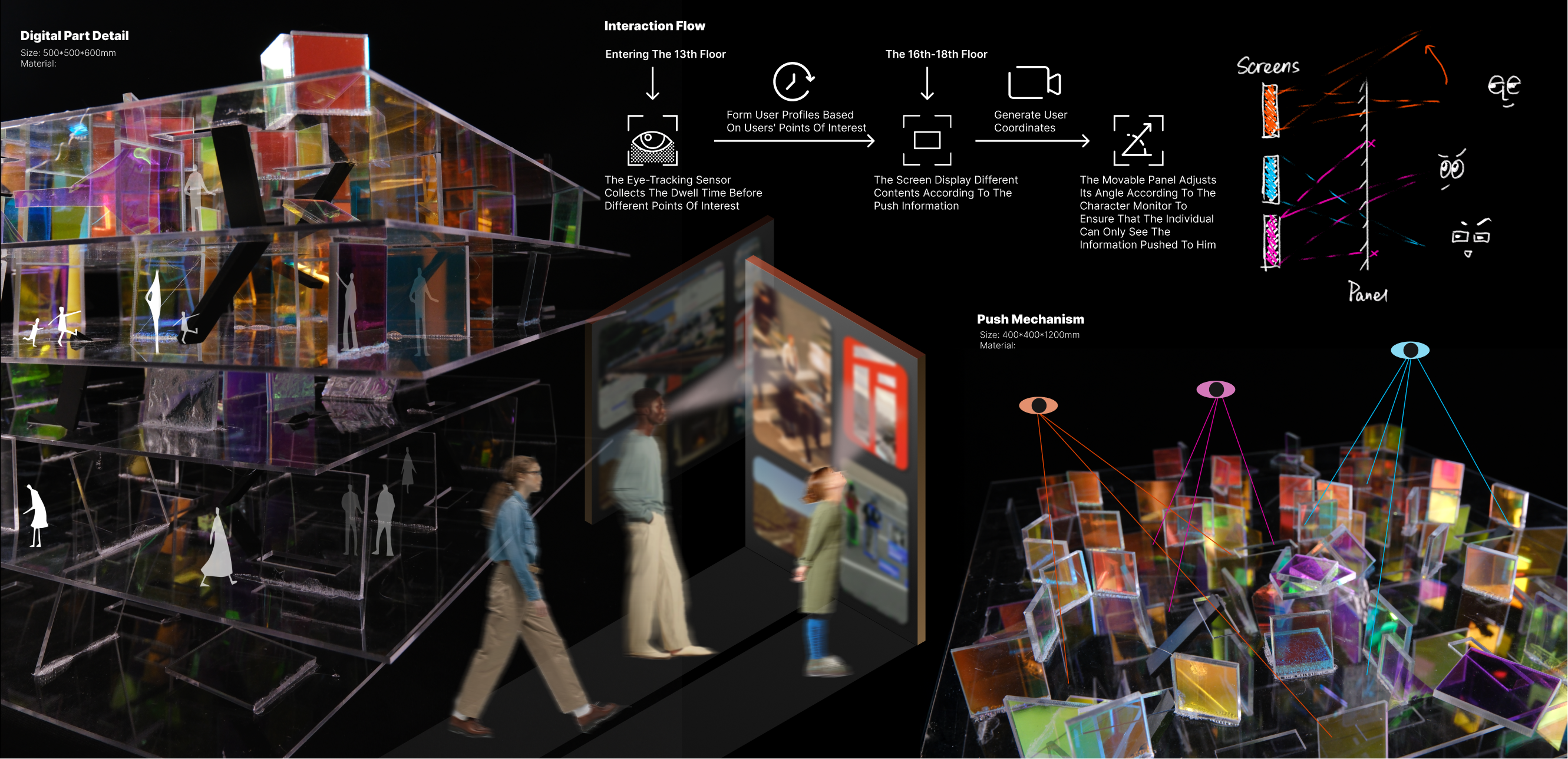
The upper floors of the tower contain a working spatial interaction system. As a user enters, an eye-tracking sensor collects dwell time on different content. The system forms a user profile, generates coordinates, and pushes content to the next floor — each screen visible only from a specific angle.
Eye-tracking sensor collects the dwell time before different points of interest.
Form a user profile based on the user's points of interest.
The screen displays different contents according to what is being pushed.
The movable panel adjusts its angle so the individual sees only what is pushed to them.
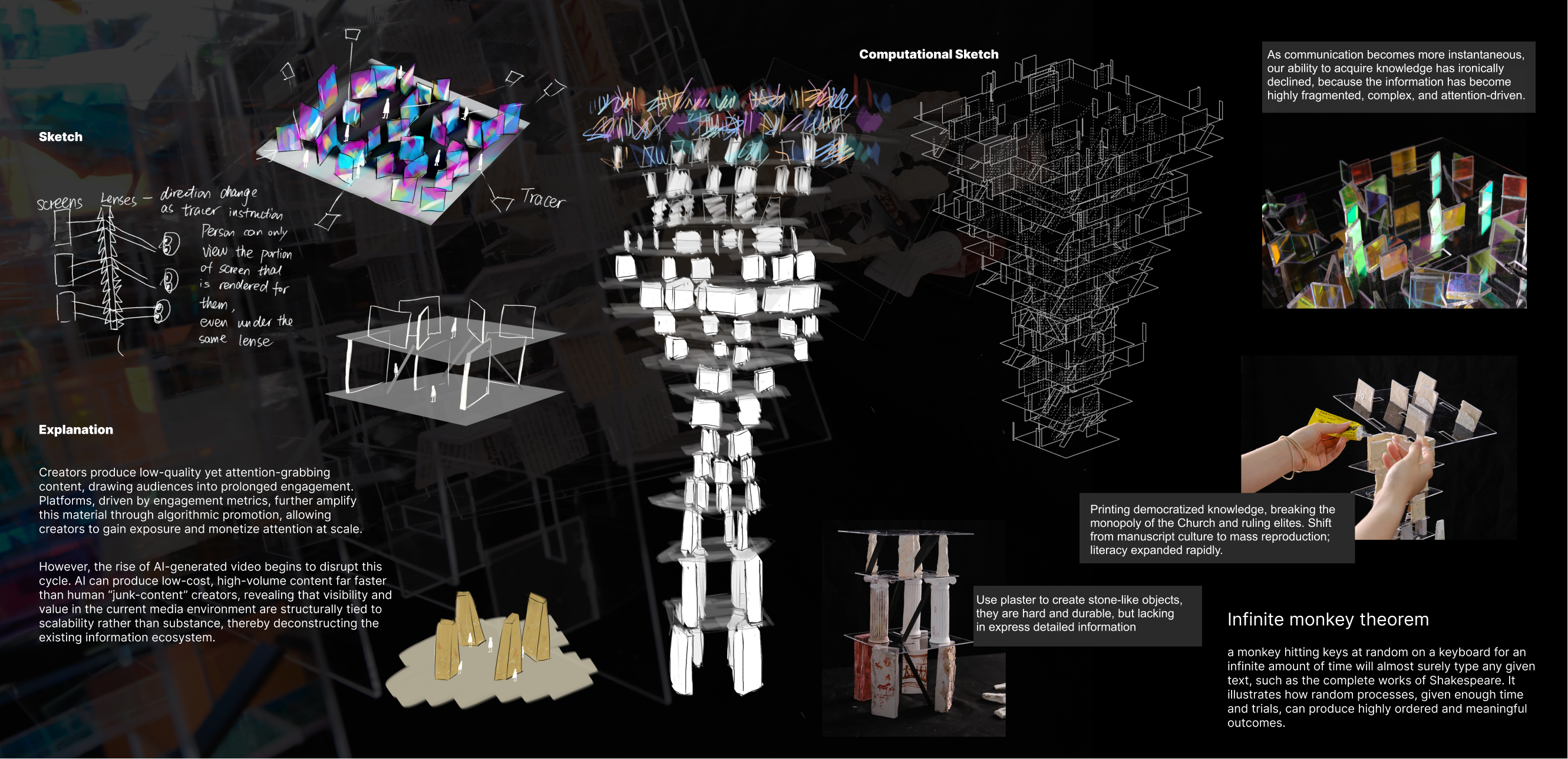
Creators produce low-quality yet attention-grabbing content, drawing audiences into prolonged engagement. Platforms, driven by engagement metrics, amplify this material through algorithmic promotion — allowing creators to gain exposure and monetize attention at scale.
However, the rise of AI-generated video begins to disrupt this cycle. AI can produce low-cost, high-volume content far faster than human "junk-content" creators — revealing that visibility and value in the current media environment are structurally tied to scalability rather than substance, thereby deconstructing the existing information ecosystem.
The development moved from quick hand sketches — screens, lenses, view angles — into computational rendering of the same architectural ideas. The structural impulse was always the same: a tall, layered, transparent volume where attention itself is the medium being displayed.
A monkey hitting keys at random on a keyboard for an infinite amount of time will almost surely type any given text — even the complete works of Shakespeare. The theorem reframes the tower's argument: the current overload of attention-driven content might, with enough scale and time, surface something meaningful. The question is whether anyone will be paying enough attention to notice when it does.
— 2025 · Zhang Yichi